



• Important Notice
  • image
  • image
  • image
  • image
  • image
Previous Next
Pinbahis Güncel Giriş ve 2026 Teknik Analizi

au leoleo icon

TUSI AU LEOLEO

tusifaitau aso icon

TUSI FAITAU ASO

autaumafai icon

TUSI AU TAUMAFAI

EFKS MUSEUM

efks museum1


 FEAU O LE VAIASO!

(Message of the week)

Tusi Faitau: Esoto 1 : 6-14

Matua: Fp 9 & 10, “Faauta, o le nuu o le fanauga a Isaraelu ua sili ona toatele ma le malosi ia tei tatou; ina o mai ia, ina tatou togafiti poto ia tei latou, nei tupu tele, ona latou tau mai ia i tatou, ma o ese I le nuu nei.”


Manatu Autū: “Fa’ailoga tagata e ‘afua ile fefe”.


I totonu ole tala faasolopito o le lalolagi, e tele ma anoanoai ni mea matuiā ma le matautia, sa mafai ona tutupu a’e ai. O le ola fa’apologaina, o le taotaomia ole saolotoga i nisi o atunuu, o le faailoga lanu e pei ona iai i totonu o Aferika i Saute, o le aiā tatau a tamaitai, ae maise ai o tapu i tapuaiga fou ma talitonuga a le tagata lava ia.

O nei mau fa’afitauli, ua tele ina maumau ai le soifua ma le ola o tagata lautele, pe a fai ae finauina e seisi le aveesea o le ola pologa ma le ola taotaomia.O le tele fo’i o nei fa’afitauli, o loo aliae mai I talitonuga i totonu o sosaiete, e a’afia ai tagata maualuluga, o tagata taualoa o ē o loo umia le malosiaga o le ‘oa ma le tamaoaiga, ma ē o lo’o umia le pule e mafai ai ona  o latou aiāina le sa’olotoga o tagata lautele. 

Ma atonu o le afuaga lea o loo fausia ai mafaufauga ma tusitusiga a nisi o le au popoto, e pei fo’i o se tasi o tamali’i iloga, lea e suafa iā Karl Marx, lea e fa’apea se tasi o ana mau, “E le’o se mea tatau le fa’atulaga ma vavae sosaiete, auā e lē maua ai se nofo fealofani. O lona uiga, e tatau ona ola tutusa tagata uma. Peita’i! e o’o mai i lenei taeao, fai mai le manatu autu, “Fa’ailoga tagata e ’afua mai ona ole fefe”.

O le tusi lenei o Esoto, o lo’o ua taliaina lava, o le tusi lona lua (2) mai i tusi e lima a Mose, e aofia ai Kenese, Levitiko, Numera ma Teuteronome, a’o le tusi o lo’o fa’auigaina mai ile upu o le gagana Eleni, e uiga tutusa ma le upu, “o ese mai” po’o le malaga ese mai o le nu’u ole Atua mai i Aikupito, le nofoaga na nofo pologa ai.

E amata mai la le tusi, i le faitauga e pei ona iai lenei taeao, o lo’o tatala lava ile toe fa’atepa o le au faitau, i igoa o fanau a Isaraelu, o ē na muamua ona o latou asaina le gasū, e ala i le ta’ita’ina ole nu’u mai ile amataga ole faigamalaga a Isaraelu. O le tala malamalama, na toe manatua ai nisi o augatamā, e pei o Iosefa. Ae fai mai ina ua mavae atu Iosefa ma ona uso, ua mou atu fo’i lea auga-tupulaga muamua sa iai, ona fanafanau lea ma ua uluola le fanauga a Isaraelu, ona tulai mai lea o le tupu fou, ole Farao lona 2, e fa’apea e nate lē iloa le augatupulaga muamua.

Talofa ile loto matāua, le fa’asiliaupule ma le fa’amaualuga. Le popole vale ma le lē mautonu, ua avea ma ala ua fa’atauasoina ai le tagata, ma ua galo ai le so’otaga ma le mafutaga mafanafana sa iai, ina a’o tula’i mai tupulaga muamua o Isaraelu ma Aikupito. Ua moni ai le manatu aoao ole vaiaso, “Fa’amaualuga ma le Fa’ailoga tagata”.

A’o le fesili, fa’ailoga tagata ile a? O le tula’i mai o Farao lona lua (2) e avea ma tupu fou, o iina na amata ai loa ona manu a’e suiga ia, ua i ā te ia le pule ma le malosiaga, ona ia tā vavae eseina lea o ona tagata ma lona nu’u, ma ua ia fa’apea ane, “Fa’auta, o le nu’u ole fanauga a Isaraelu, ua sili ona to’atele ma le malosi ia te’i tatou. Inā tatou togafiti poto ia i a te’i latou.” A mafaufau ile upu togafiti, e pei ona fa’aogaina e le tupu o Aikupito, e leai se fa’amoemoe o se togafiti e iai sona taunu’uga lelei, ae ua na’o se faufauga ina ia fa’atino se galuega ma le fa’amoemoe, ia ta’u maualaloina ai seisi tagata.

Lea la e pei ona iai le vaega ole tala, ua o’o ifo lagona ma ua manatu le tupu i faiga fa’asausili, ina ia manumalo le pule so’ona fai. E ui lava i ni galuega lelei sa faia e Isaraelu ma ona tagata, aemaise o nai o latou tuaā, lea lava ua manino le mata o le vai, ole fefe o Farao, ua fai lea ma ala ua fa’ailogaina ai le tagata ese ma le tagata ole nu’u, ua avea fo’i faiga fa’asausili ma ala ua fa’ailoga ai le Isaraelu ma le Aikupito. A’o a’afiaga ogaoga ia ole fefe ma le atuatuvale, ua lē gata ile tafili saunoa i upu fa’atigā, a ua fa’apea fo’i i galuega mamafa ina ia o’oo’o le ta ole fa’apologaina.

Pau lava lea o le vaega tāua o lo’o fa’ailoa mai ai i lenei tala, ia aua lava ne’i galo le sao o i latou na fitā-i-tuga i le galuega, o ē ua mavae atu, sa fai ma va’aiga a latou galuega e pei o Iosefa ma ona uso, i tupulaga fou ma e ua fai mai, o le ata fa’atusa o le lē fa’ailoga tagata i fa’afitauli e fetaia’i i so’o se ala.

E manatu o lea fo’i se feau toe fagufagu mo itatou ma la tatou ofisa, a’o tatou iai ile fa’aauauina o feau ma galuega, o galuega ma matafaioi tu’u fa’asolo ua au tausagā o galulue ma punonou ai nisi o tamā, o tinā aemaise i latou o e sa mua i malae auā le tautuaina o le Ekalesia.

O le upu a e masani a’i le fa’alogo, e omai tupulaga ma o, lea fo’i ua o’o mai lo tatou taimi, ua ia’i tatou le avanoa e fa’atino ai lau tautua ma sa’u auaunaga, o le fealofani ma le maopopoga o lenei ofisa, e le’o le fa’ailoga tagata, a’o le tutusa o tagata uma. O le fa’amanatu fo’i a le talalelei mo i tatou, e le’o le ita, e le’o le fefe ma le atuatuvale, tatou te faia ai fa’aiuga ma le fa’amoemoe e fo’ia ai fa’afitauli o le ola nei.

I le ma lenei, e iai lava matagi vale ma fa’afitauli e fesouaina ina lo tatou sa folau, peita’i o le fa’amoemoe, ma le fa’alagolago i le mana o le Agaga o le Ali’i, ua na’o le pau lea o le fesoasoani sili e mapu iai le tagata saisaitia, ma to’omaga iai le tagata pagātia.

O Iesu Keriso, o le fa’ataiga lea o le loto maualalo na fa’atinoina ai lana galuega, na o’o lava i le Satauro matagā, n ate le’i fa’apito manū i a tasi, pe na fa’ailoga ni tagata mo lana fa’aolataga, peita’i, na manumalo lona alofa ina ua ia alofaina le lalolagi uma, e ala i lona maliu, ma lona toetū manumalo mai ile oti ma le tu’ugamau, ina ia o saofagā oe ma a’u i lona malo e fa’avavau,

AMENE.


                                                                                                               Collin Faletoese (FS)  

                                                                                                                                                                  ………………………………………

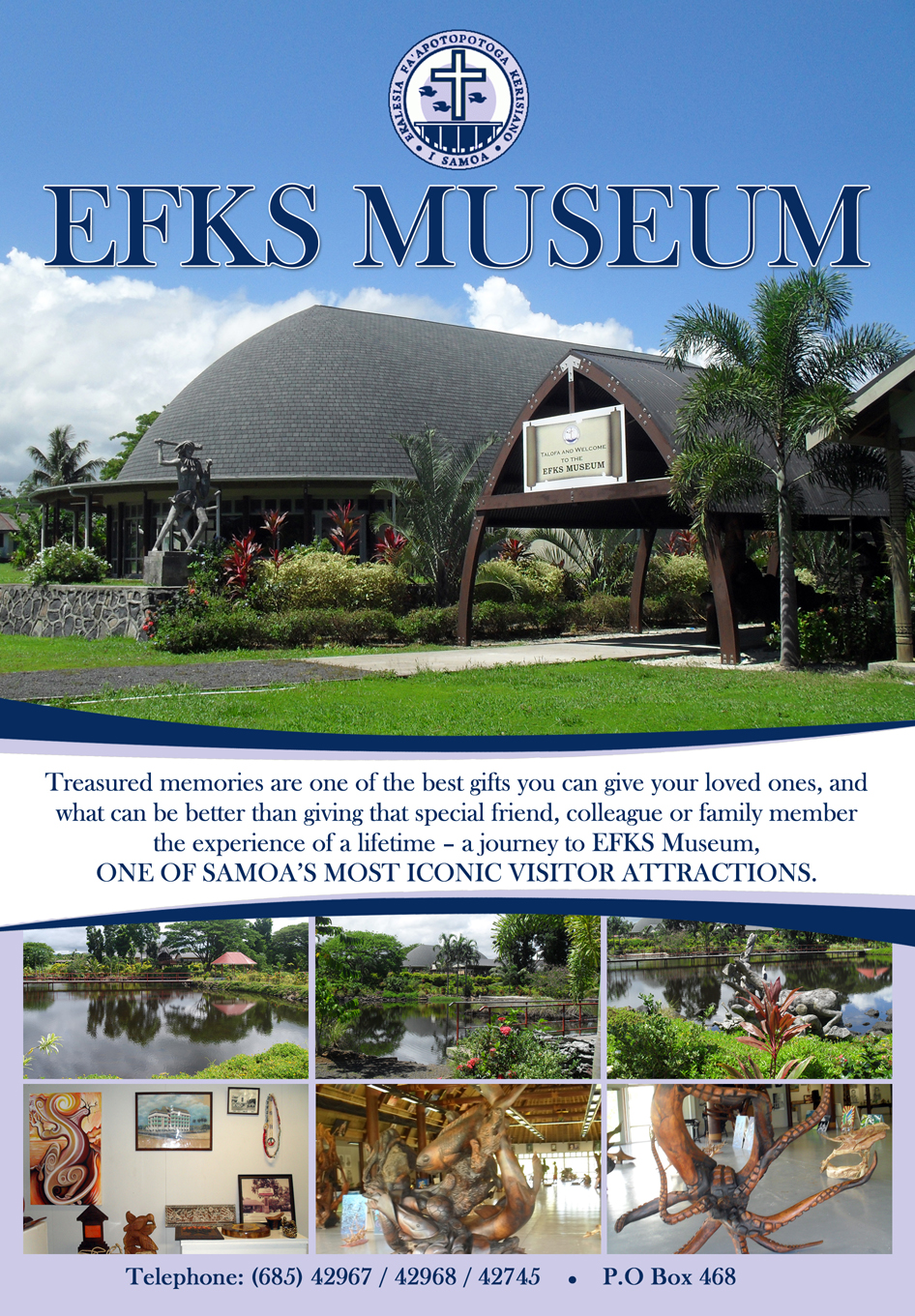
At a height of 4m, EFKS Museum is situated approximately twelve miles west of the capital of Apia and about the same distance east of Faleolo International Airport. It was a new and Samoa’s largest Museum and tourist attractions.

The EFKS Museum has been in the pipeline for some time but at the General Assembly of 2007, it was approved to start work on it with the allocated funds already earmarked for the project.

The ground breaking of the Museum project started in 2009, and the construction completed with the opening on Thursday May 12, 2011. The launching service was led by the then chairman of the Congregational Christian Church of Samoa, Rev Elder Tavita Roma.

With high standards of service, the dedicated team at EFKS Museum is committed to providing visitors with an experience to remember.

Design Concepts

The project master builder was Lale Ieremia Jr (Arrow International Ltd), who descends from a prominent family of the Church.

It is a very attractive piece of architect located within the vicinity of Malua, consisting of a large, high ceiling glass walled Samoan Fale, with office rooms in the front and the back. The front section entry to the main building and to the hull have open-air walkways on both sides decorating with beautiful carvings and statues which tell its own unique story or tale from Samoan ancestors myths. The most northern section of the Museum facing the main road seaside depict the hull of the vessel that brought the first English missionary, Rev John Williams, who brought the LMS church to Samoa and the fulfillment of Nafanua’s prophecy.

Attractive board walkways are built on a man-made turtle and fish bond in front of the Museum, which are enclosed by a high brick wall fence in the front near the main road.

s

History and Milestones

A certain feature at the entrance of the Museum is the statue of the Samoan goddess Nafanua, who prophesied to Malietoa Vainuupo the arrival of Christianity to Samoa. This was widely accepted as coming to pass when John Williams arrived with the Gospel of Jesus Christ at Sapapalii Savaii in the year 1830.

During the opening of the Museum, the then Acting Prime Minister Tuiloma Pule Lameko described the project as “the Church’s biggest contribution to the tourism and economic development” in history.


“Perhaps the mythical fale (house) at Amoa looked something like this. It is truly a magnificent building. Not only will it be a money spinner for the country, but it will also serve as an archive for church documents and church history,” Said Tuiloma.


On display at the museum are old printing presses that were used in the early days of the church. “These printing presses were used to translate the bible and put Samoan language in writing. This was how Samoa learned to read and write, thanks to the work of the early missionaries who established the Samoan alphabet.” Tuiloma said the museum would be a regular stop for tourists travelling from Faleolo Airport to Apia.

The invited guests for the opening day donated a total of SAT$110,373.26. Notable gifts presented were 150 chairs from faletua Tifilelei Ieremia along with Uilelea Uilelea who donated a Bible. Other donors included United Church of Christ, Lapana Faletolu and PIC Christchurch, Arrow International Ltd and Ricoh New Zealand.


The man-made pond in front of the museum was made possible through kind donations from CWM Pacific who donated SAT$54,834.58, CWM Global’s SAT$216,904.48 along with PCC Kafa Fund (Fiji) and Ricoh Samoa EFKS who donated SAT$7,000.00 and SAT$50,000 respectively.


The administration and day to day running of the Museum was to be handled by the General Purposes Committee (KFE). The Schools Committee (KA) was also to assist especially with the involvement of the School of Fine Arts. The Museum was to house and display the works of the School of Fine Arts who would also use the building for Arts studies and research. Furthermore it would also store significant and historical artifacts of the Church along with her history.

It closed its doors to the public in March 11, 2013 (twenty one months after the official opening in May 2011). It has just re-opened again in July 24 2013 with its new Manager looking after its operation since 26 August 2013.